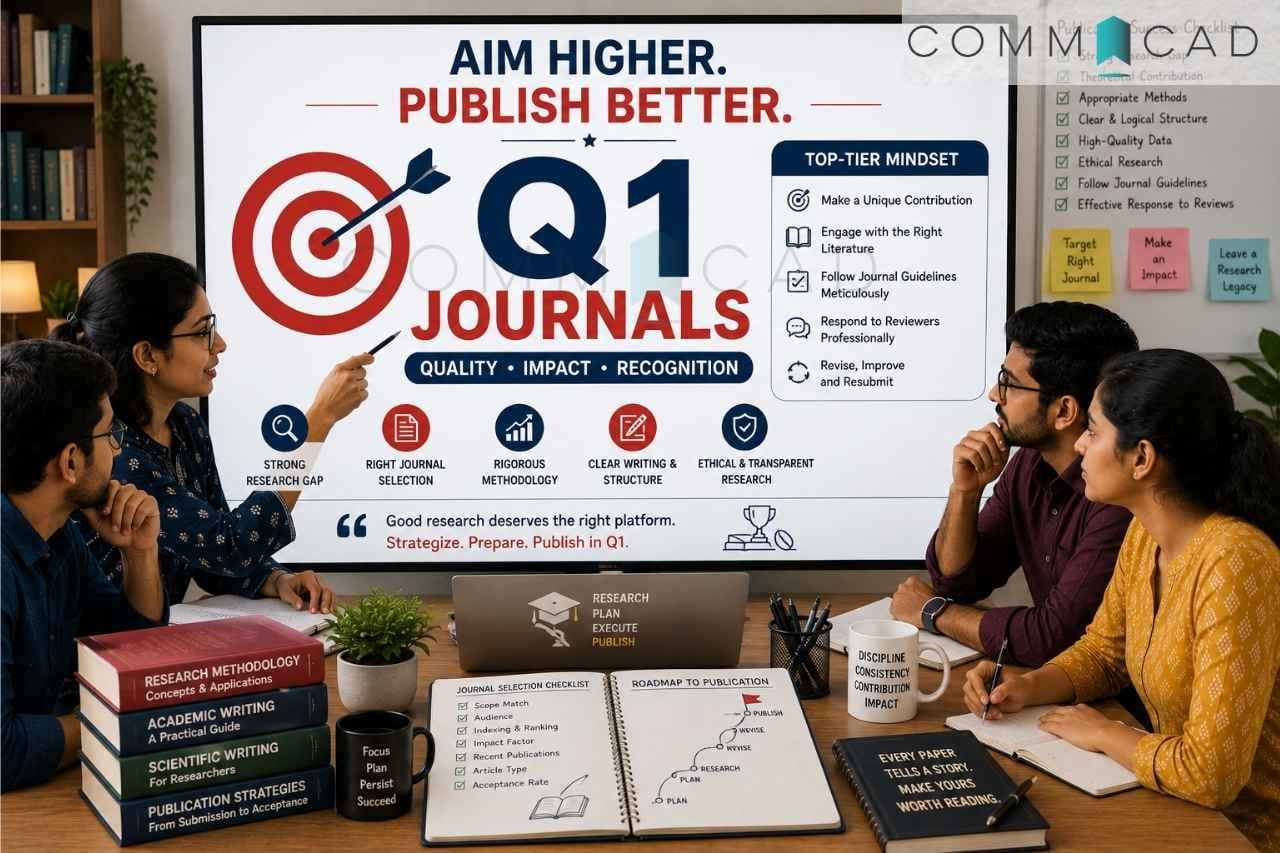
10 Strategies for Publishing in Q1 and Top-Tier Journals
Publishing a research paper is an achievement. Publishing it in a highly regarded journal, however, requires a different level of preparation.
Researchers often ask:
"How can I get my paper published in a Q1 journal?"
There is no secret formula, and no strategy can guarantee acceptance. However, there are several decisions researchers can make before and during submission that can substantially improve the quality, positioning, and competitiveness of a manuscript.
Publishing in a top-tier journal is not simply about having an interesting topic or using sophisticated statistical techniques. Editors and reviewers are looking for research that is relevant, rigorous, clearly communicated, and capable of making a meaningful contribution to the field.
Here are ten practical strategies that can help researchers approach high-quality journal publication more strategically.
First, What Do "Q1," "Scopus," and "Top-Tier" Actually Mean?
Before discussing publication strategies, it is important to clarify a common misconception.
Scopus is a research abstract and citation database. Being indexed in Scopus does not automatically make a journal Q1 or top-tier.
Q1 generally refers to a journal being placed in the first quartile of a particular journal-ranking or subject-category system. The exact ranking system and category matter.
Similarly, "top-tier journal" is a broader description that may consider a journal's reputation, selectivity, influence, readership, editorial standards, and standing within a particular discipline.
Therefore, researchers should avoid treating these terms as interchangeable.
A better question is:
Is this journal a strong and appropriate publication venue for my particular research?
That question leads to the first strategy.
1. Choose Your Target Journal Early
One of the most common mistakes researchers make is writing the entire manuscript and only then deciding where to submit it.
Journal selection can be much more strategic when considered early.
Before finalizing your manuscript, examine potential journals for:
Scope and aims
Types of studies published
Target readership
Methodological preferences
Typical article structure
Recent publications
Editorial priorities
You do not need to write your paper for a journal in the sense of changing your research to fit it.
Instead, understanding the journal helps you determine whether your research genuinely belongs there.
A useful rule:
Do not ask only, "Is this a good journal?"
Ask:
"Is this the right journal for this particular paper?"
2. Read the Journal (Not Just Its Homepage)
Reading a journal's "Aims & Scope" page is useful, but it is not enough.
Spend time reading several recent papers published in the journal.
Look for patterns:
What kinds of research questions are being published?
What populations and contexts are represented?
What methodological approaches are common?
How are contributions framed?
What does the discussion section emphasize?
What level of theoretical or practical contribution is expected?
Recent articles can reveal the journal's actual publishing preferences much better than a short description on its website.
This is one of the simplest—and most overlooked—ways to assess journal fit.
3. Make the Contribution Clear
A strong topic does not automatically mean a strong contribution.
A reviewer may appreciate your subject but still ask:
"What does this study add to existing knowledge?"
Your manuscript should answer this question clearly.
A contribution might involve:
Addressing an important research gap
Challenging an existing assumption
Extending a theoretical framework
Providing evidence from an understudied context
Introducing a new methodological perspective
Resolving contradictory findings
Generating meaningful practical implications
The important point is that the contribution should be demonstrated, not simply claimed.
Saying that a study is "novel" is not enough.
Explain what is new, why it matters, and how it advances existing knowledge.
4. Make the Research Gap Easy to Find
Researchers sometimes hide their research gap beneath several pages of literature review.
This can make an otherwise strong manuscript difficult to evaluate.
A reviewer should be able to understand:
What is already known → What remains unclear → Why that matters → What your study does about it.
Your literature review should therefore do more than summarize previous studies.
It should build an argument.
Instead of presenting:
Study A found X.
Study B found Y.
Study C found Z.
Connect the literature and show what the collective evidence tells us—and where uncertainty remains.
A strong literature review doesn't simply demonstrate that you have read extensively.
It demonstrates that you understand the conversation and can identify where your research belongs within it.
5. Don't Confuse Complexity with Research Quality
Another common misconception is that sophisticated methodology automatically increases publication potential.
It does not.
A complex statistical model cannot compensate for:
A poorly defined research question
Weak theoretical grounding
Inadequate sampling
Poor measurement
An unclear research gap
Likewise, a relatively simple analytical approach can produce an excellent paper when it is appropriate for the research question and executed rigorously.
The right question is not:
"What is the most advanced method I can use?"
It is:
"What method most appropriately answers my research question?"
Methodological alignment is more important than methodological complexity.
6. Treat the Title and Abstract as Strategic Elements
Editors and reviewers encounter enormous numbers of manuscripts.
Your title and abstract therefore matter.
A strong title should communicate the central subject of the study without unnecessary complexity.
The abstract should quickly establish:
The research problem
The purpose of the study
The methodological approach
The key findings
The principal contribution
Avoid turning the abstract into a miniature literature review.
The reader should finish it knowing:
What did you study, how did you study it, what did you find, and why does it matter?
7. Study the Journal's Author Guidelines Carefully
This sounds basic, but it is surprisingly important.
Before submission, check:
Word limits
Manuscript structure
Reference style
Figure and table requirements
Supplementary material requirements
Ethical declarations
Reporting requirements
Data availability requirements
Submission-specific documents
Failure to follow instructions may not automatically result in rejection, but avoidable submission problems can create unnecessary friction during editorial screening.
A strong manuscript should also be technically prepared for the journal to which it is being submitted.
8. Use References Strategically (Not Artificially)
Your references should demonstrate that your research is connected to the relevant scholarly conversation.
This means:
Use recent literature where appropriate
Include foundational studies where necessary
Engage with important debates
Cite relevant work from the target field
It can also be useful to examine recent publications from your target journal and identify relevant literature.
But there is an important distinction:
Do not add citations simply to increase the appearance of journal engagement or manipulate citation metrics.
Every citation should have a scholarly reason for being there.
Good referencing demonstrates intellectual engagement—not strategic padding.
9. Treat the Submission Package as Part of the Manuscript
The manuscript is the central component of a submission, but it is not always the only thing an editor sees.
Depending on the journal, you may also need:
Cover letter
Highlights
Graphical abstract
Author statements
Conflict-of-interest declarations
Data availability statements
Ethical approval information
A professional submission should communicate that the research is ready for editorial consideration.
A cover letter, in particular, should briefly explain:
What the study investigates
Why it is relevant
What the main contribution is
Why the manuscript fits the journal
It should not simply repeat the abstract.
10. Learn to Use Rejection and Reviewer Feedback
Perhaps the most important strategy is understanding that rejection is part of academic publishing.
A manuscript can be rejected for many reasons:
Poor journal fit
Editorial priorities
Insufficient novelty
Methodological concerns
Weak theoretical contribution
Presentation problems
Reviewer disagreement
Not every rejection means the research is poor.
At the same time, researchers should not automatically assume that every rejection is simply "the reviewer's opinion."
Sometimes reviewer feedback identifies genuine weaknesses.
Read the comments carefully and ask:
What can I improve before submitting this elsewhere?
A rejection can therefore become part of the manuscript development process.
What Researchers Often Get Wrong About Q1 Journals
The desire to publish in a Q1 or highly ranked journal can sometimes create unrealistic expectations.
Here are a few misconceptions worth avoiding.
"If my journal is indexed in Scopus, it is automatically a Q1 journal."
Not necessarily. Indexing and quartile rankings are different concepts.
"A Q1 journal will accept only sophisticated research methods."
Not necessarily. Methodological sophistication must be appropriate to the research question.
"More citations will make my paper publishable."
A large reference list does not substitute for a meaningful research contribution.
"Using AI will make my manuscript publication-ready."
AI can assist with certain research and writing tasks, but it cannot substitute for methodological judgment, scholarly interpretation, or responsibility for the manuscript.
"There is a formula for getting published."
There isn't.
Publication decisions involve research quality, contribution, journal fit, editorial priorities, reviewer assessments, and many other factors.
A Better Way to Think About Top-Tier Publication
Instead of thinking:
"How do I get my paper into a Q1 journal?"
consider asking:
"How do I develop a manuscript that deserves to be considered by a strong journal?"
That shift in mindset changes the entire publication strategy.
You begin to focus on:
Research problem → Contribution → Methodological rigor → Clear communication → Journal fit → Strategic submission
rather than simply chasing a ranking.
A Pre-Submission Checklist
Before submitting your manuscript, ask yourself:
Research
Is the research question important and clearly defined?
Is the research gap genuinely supported by literature?
Is the contribution clearly articulated?
Methodology
Is the research design appropriate?
Are sampling and data collection adequately justified?
Are the analytical methods aligned with the research questions?
Manuscript
Is the argument easy to follow?
Are the findings clearly presented?
Does the discussion go beyond simply repeating the results?
Are limitations acknowledged honestly?
Journal
Does the manuscript genuinely fit the journal?
Have you examined its recent publications?
Have you followed its author guidelines?
Is the journal's reputation and indexing status verified?
Submission
Are all required documents prepared?
Is the cover letter concise and relevant?
Have ethical and disclosure requirements been addressed?
If several answers are "no," the manuscript may benefit from further development before submission.
Final Thoughts
Publishing in Q1 and top-tier journals is competitive, but it should not be approached as a search for a secret publishing hack.
The strongest strategy is to build a strong research paper and then position it intelligently.
A meaningful research question, clearly demonstrated contribution, rigorous methodology, appropriate journal selection, and careful manuscript preparation can significantly strengthen a submission.
Most importantly, remember that journal ranking should not become the sole measure of research quality.
The ultimate goal of academic publishing is not simply to obtain a Q1 label next to your publication.
It is to contribute something valuable to your field. And to place that contribution in a journal where the right academic community can engage with it.
-Commacad Experts