How AI Tools Are Transforming Systematic Reviews and Meta-Analysis
Introduction
Systematic Reviews and Meta-Analysis (SRMAs) are widely regarded as some of the highest levels of evidence in research. They provide researchers, clinicians, policymakers, and organizations with comprehensive insights derived from existing literature.
However, anyone who has conducted an SRMA knows that the process is rarely simple.
Developing a robust protocol, constructing comprehensive search strategies, screening hundreds of studies, extracting data, and interpreting results can require months of work.
While methodological rigor remains essential, researchers today are increasingly exploring how Artificial Intelligence (AI) can help streamline parts of the process without compromising quality.
In recent years, AI-powered research tools have emerged to support researchers across different stages of the SRMA workflow. Rather than replacing researchers, these tools help reduce repetitive tasks, improve consistency, and support evidence-based decision-making.
Why SRMAs Are Challenging
A typical systematic review involves several critical stages:
Defining a research question
Developing a protocol
Designing database search strategies
Screening studies
Extracting data
Assessing study quality
Synthesizing findings
Interpreting results
Each stage requires careful planning and methodological precision.
Common challenges include:
Developing complete and reproducible protocols
Constructing database-specific search strings
Ensuring comprehensive literature retrieval
Managing large volumes of studies
Interpreting complex quantitative outputs
This is where AI-assisted research tools can offer substantial support.
The Role of AI in Systematic Reviews and Meta-Analysis
AI tools can help researchers by:
Reducing manual workload
Improving consistency
Supporting methodological decisions
Enhancing transparency
Accelerating research workflows
Importantly, AI should be viewed as an assistant rather than a replacement for researcher expertise.
The final decisions remain with the researcher.
Stage 1: Protocol Development with Protocolis™
A well-designed protocol forms the foundation of a high-quality systematic review.
Unfortunately, many researchers struggle with:
Defining eligibility criteria
Structuring review objectives
Selecting appropriate review methods
Ensuring methodological completeness
This is where Protocolis™ becomes valuable.
Protocolis™ is designed to support researchers in developing systematic review protocols by helping organize and structure key methodological components.
Researchers can use Protocolis™ to:
Define review objectives
Develop inclusion and exclusion criteria
Structure eligibility frameworks
Improve protocol completeness
Enhance methodological consistency
Rather than starting with a blank page, researchers can build a stronger foundation for their review process.
Stage 2: Search Strategy Development with StrinGen™
A systematic review is only as good as its search strategy.
One of the most common reasons reviews miss relevant studies is the use of incomplete or poorly constructed search strings.
Researchers often face challenges such as:
Identifying relevant keywords
Generating synonyms
Using Boolean operators effectively
Adapting searches across databases
StrinGen™ was developed to address these challenges.
StrinGen™ assists researchers in creating comprehensive search strategies by helping generate structured search strings suitable for major databases.
Researchers can use StrinGen™ to:
Identify relevant search concepts
Expand keyword combinations
Generate Boolean search structures
Improve search comprehensiveness
Increase retrieval efficiency
The result is a more systematic and reproducible search process.
Stage 3: Data Interpretation with QuantiPreter™
After study selection and data extraction comes another challenge: interpreting findings.
Many researchers struggle with:
Understanding statistical outputs
Interpreting effect sizes
Explaining heterogeneity
Translating results into meaningful conclusions
This is where QuantiPreter™ becomes particularly useful.
QuantiPreter™ supports researchers in understanding and interpreting quantitative findings generated during evidence synthesis and meta-analysis.
Researchers can use QuantiPreter™ to:
Interpret statistical outputs
Understand effect sizes
Explore heterogeneity indicators
Improve result reporting
Develop clearer discussions and conclusions
By simplifying interpretation, researchers can focus more on the implications of their findings rather than becoming overwhelmed by statistical complexity.
Building an AI-Assisted SRMA Workflow
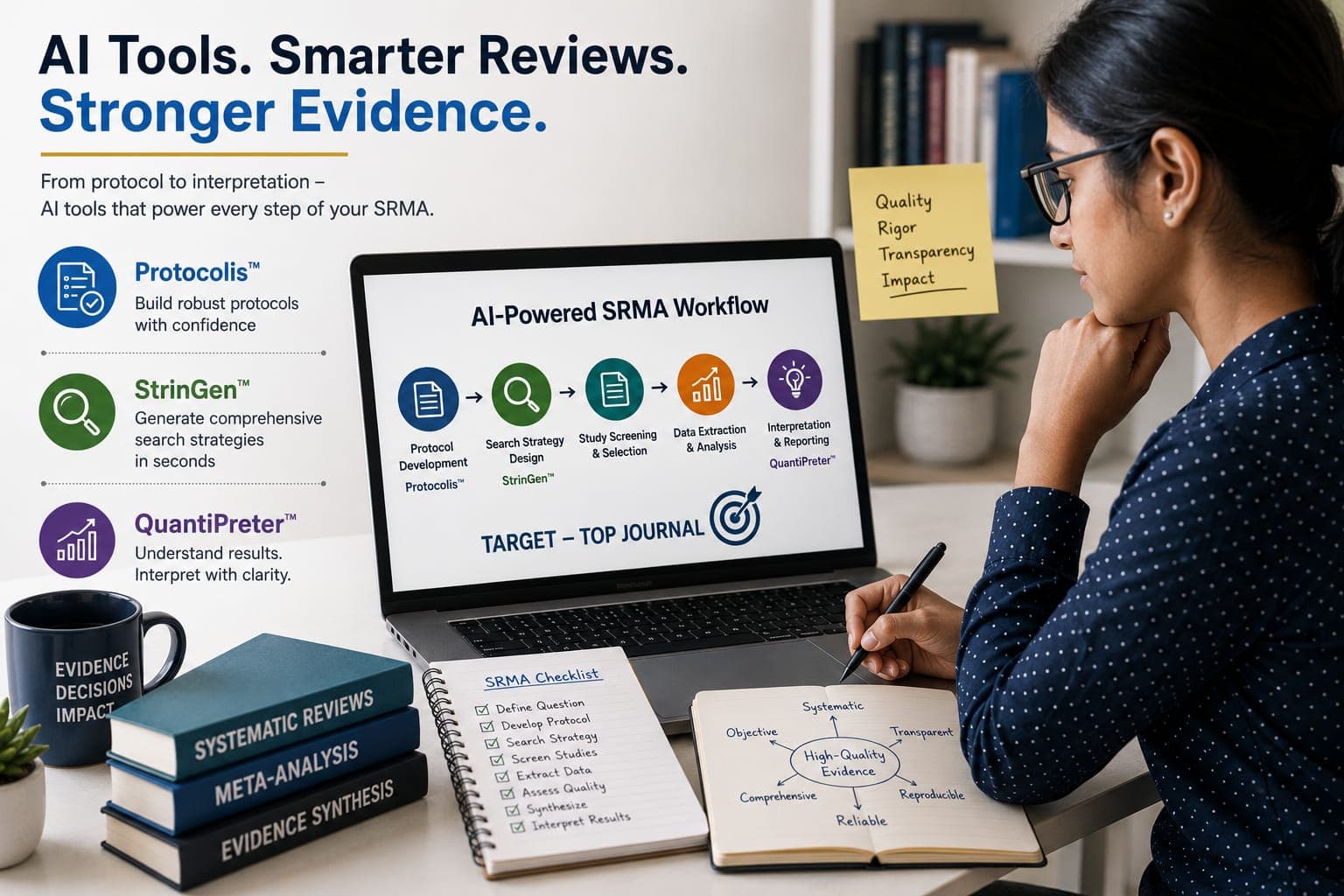
A modern AI-assisted SRMA workflow may look like this:
Step 1: Plan the Review
Use Protocolis™ to structure the protocol and review framework.
Step 2: Develop Search Strategies
Use StrinGen™ to create comprehensive database search strings.
Step 3: Conduct Literature Searches
Retrieve studies from relevant databases.
Step 4: Screen and Select Studies
Apply inclusion and exclusion criteria.
Step 5: Extract and Analyze Data
Conduct evidence synthesis and meta-analysis.
Step 6: Interpret Results
Use QuantiPreter™ to support interpretation and reporting.
This workflow allows researchers to spend less time on repetitive tasks and more time on critical evaluation and scientific reasoning.
Benefits of AI-Assisted SRMA Research
Researchers using AI-supported workflows may benefit from:
✔ Improved efficiency
✔ Better methodological consistency
✔ Enhanced transparency
✔ Reduced manual effort
✔ Faster project completion
✔ Stronger reproducibility
Most importantly, AI tools help researchers focus on what matters most: generating meaningful evidence.
Final Thoughts
Systematic Reviews and Meta-Analysis remain among the most rigorous forms of research, but they are also among the most demanding.
As research continues to evolve, AI-powered tools are becoming valuable partners in supporting methodological quality and workflow efficiency.
Tools such as Protocolis™, StrinGen™, and QuantiPreter™ demonstrate how AI can assist researchers throughout the review process—from protocol development and search strategy design to the interpretation of findings.
The future of evidence synthesis is unlikely to be fully automated. Instead, it will likely combine the strengths of human expertise and artificial intelligence, creating smarter, more efficient, and more reproducible research workflows.
Responsible Use of AI in Evidence Synthesis
AI tools can significantly improve efficiency throughout the systematic review and meta-analysis process. However, they should be used as decision-support systems rather than decision-makers. Researchers remain responsible for methodological choices, study selection, data verification, interpretation of findings, and adherence to reporting standards. Responsible use of AI combines technological assistance with scholarly judgment, ensuring that research integrity remains central to the review process.
-Commacad Experts Team