How to Use AI Tools for Mixed Methods Research: From Research Design to Data Integration
Mixed methods research offers researchers the opportunity to combine the strengths of both quantitative and qualitative approaches. It allows numbers and narratives to work together, creating richer and more comprehensive insights.
However, anyone who has conducted mixed methods research knows that the process can quickly become complex.
Researchers often struggle with:
Selecting an appropriate mixed methods design
Deciding where integration should occur
Aligning quantitative and qualitative findings
Interpreting conflicting results
Structuring the overall methodology
This is where Artificial Intelligence (AI) is increasingly becoming a valuable research companion.
Rather than replacing researchers, AI tools can support planning, organization, and interpretation—reducing time spent on technical challenges and allowing researchers to focus on critical thinking.
Why Mixed Methods Research Can Be Challenging
Mixed methods research involves more than simply conducting a survey and an interview.
Researchers need to answer questions such as:
Should data collection happen simultaneously or sequentially?
Which component should have priority?
At what stage should findings be integrated?
How should conflicting findings be interpreted?
Which mixed methods design best suits the study objectives?
Without clear planning, studies can become methodologically inconsistent.
How AI Can Support Mixed Methods Research
AI can support researchers in multiple stages:
1. Research Design Development
AI can assist in:
Identifying suitable mixed methods designs
Structuring research objectives
Suggesting methodological pathways
Improving consistency between research questions and methods
2. Method Selection
AI tools can help determine:
Whether explanatory sequential design is appropriate
Whether exploratory design may be more suitable
If convergent design should be considered
3. Data Organization
AI can support:
Organizing qualitative themes
Structuring quantitative outputs
Creating cleaner research workflows
4. Data Integration and Interpretation
One of the biggest challenges in mixed methods research is integration.
AI can help researchers:
Identify relationships between findings
Highlight convergence or divergence
Suggest potential interpretations
Using AI in Mixed Methods Research: Practical Workflow
Step 1: Begin with Study Objectives
Clearly define:
What problem are you investigating?
What do you want to understand?
Why are both qualitative and quantitative approaches necessary?
Step 2: Develop the Research Design
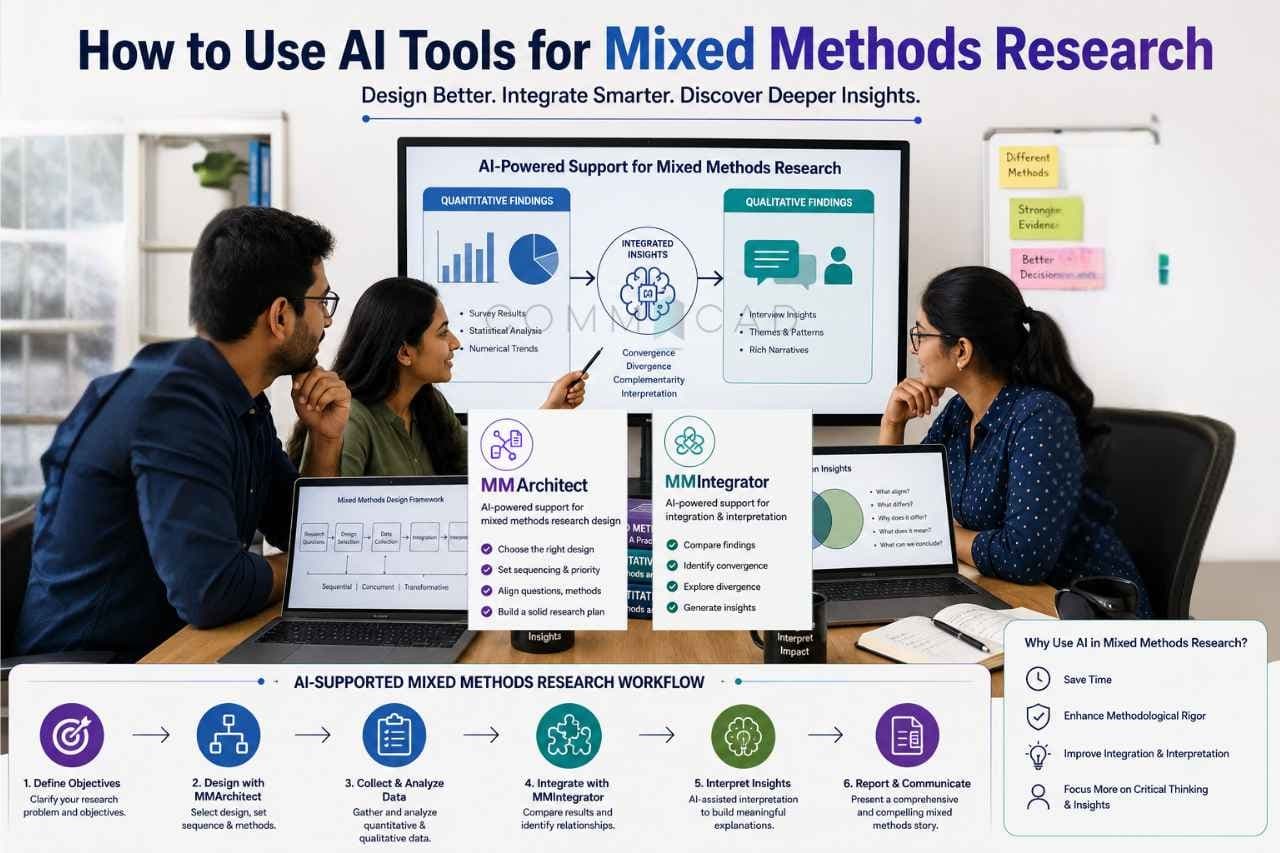
This is where tools such as MMArchitect become useful.
MMArchitect helps researchers structure mixed methods studies by supporting:
Design selection
Sequencing decisions
Priority determination
Methodological alignment
Instead of manually navigating multiple frameworks, researchers receive structured guidance during planning.
For example:
A researcher studying patient satisfaction may need to determine:
Survey first, then interviews?
Interviews first, then survey development?
Parallel data collection?
MMArchitect can support these early decisions.
Step 3: Conduct Data Collection and Analysis
Once the study design is finalized:
Quantitative component
Surveys
Statistical analysis
Numerical trends
Qualitative component
Interviews
Focus groups
Thematic analysis
Step 4: Integrate Findings
This stage often creates the greatest difficulty.
Researchers frequently ask:
"My statistical findings and interview findings do not completely agree—what should I do?"
This is where MMIntegrator becomes valuable.
MMIntegrator supports researchers by helping:
Compare quantitative and qualitative findings
Identify convergence
Identify divergence
Explore complementary relationships
Generate structured interpretation pathways
For example:
Quantitative findings:
Students reported high satisfaction scores.
Qualitative findings:
Interviews revealed concerns regarding accessibility and workload.
Rather than viewing these as contradictions, MMIntegrator may help identify that students were generally satisfied overall, while specific contextual issues remained.
Benefits of AI Tools in Mixed Methods Research
Using AI-assisted tools may help researchers:
✔ Reduce planning time
✔ Improve methodological consistency
✔ Support evidence-based integration
✔ Reduce confusion during interpretation
✔ Improve research workflow efficiency
Important Consideration: AI Should Support, Not Replace Research Judgment
AI tools can accelerate research processes, but they should not replace:
Critical thinking
Subject expertise
Methodological understanding
Ethical decision-making
Researchers remain responsible for interpretation and final decisions.
AI functions best as an intelligent assistant—not as an independent researcher.
Final Thoughts
Mixed methods research has tremendous potential because it combines the strengths of quantitative and qualitative inquiry. However, designing and integrating these approaches can become challenging without structured support.
AI tools are beginning to bridge this gap by helping researchers move from uncertainty to clearer methodological decisions.
Tools such as MMArchitect and MMIntegrator represent a shift toward more guided and efficient mixed methods workflows—allowing researchers to spend less time struggling with structure and more time generating meaningful insights.
- Commacad Experts